Showing posts with label tagane. Show all posts
Saturday, 15 August 2015
Sunday, 26 July 2015
Tiaan Burger part 2
One of the major advantages I gained from the visit with Tiaan was to be able to see both the tools and some finished pieces in real life. Pictures and descriptions can be very misleading when trying to learn about something entirely new.
Tiaan's tagane were much more refined than the ones I had made thus far. The body and points were smaller. The angle of the cutting edge was steeper. These are things I find you can only see when actually holding an object. Tiaan is also very experienced with forging and working with steel so his tools are excellently made.
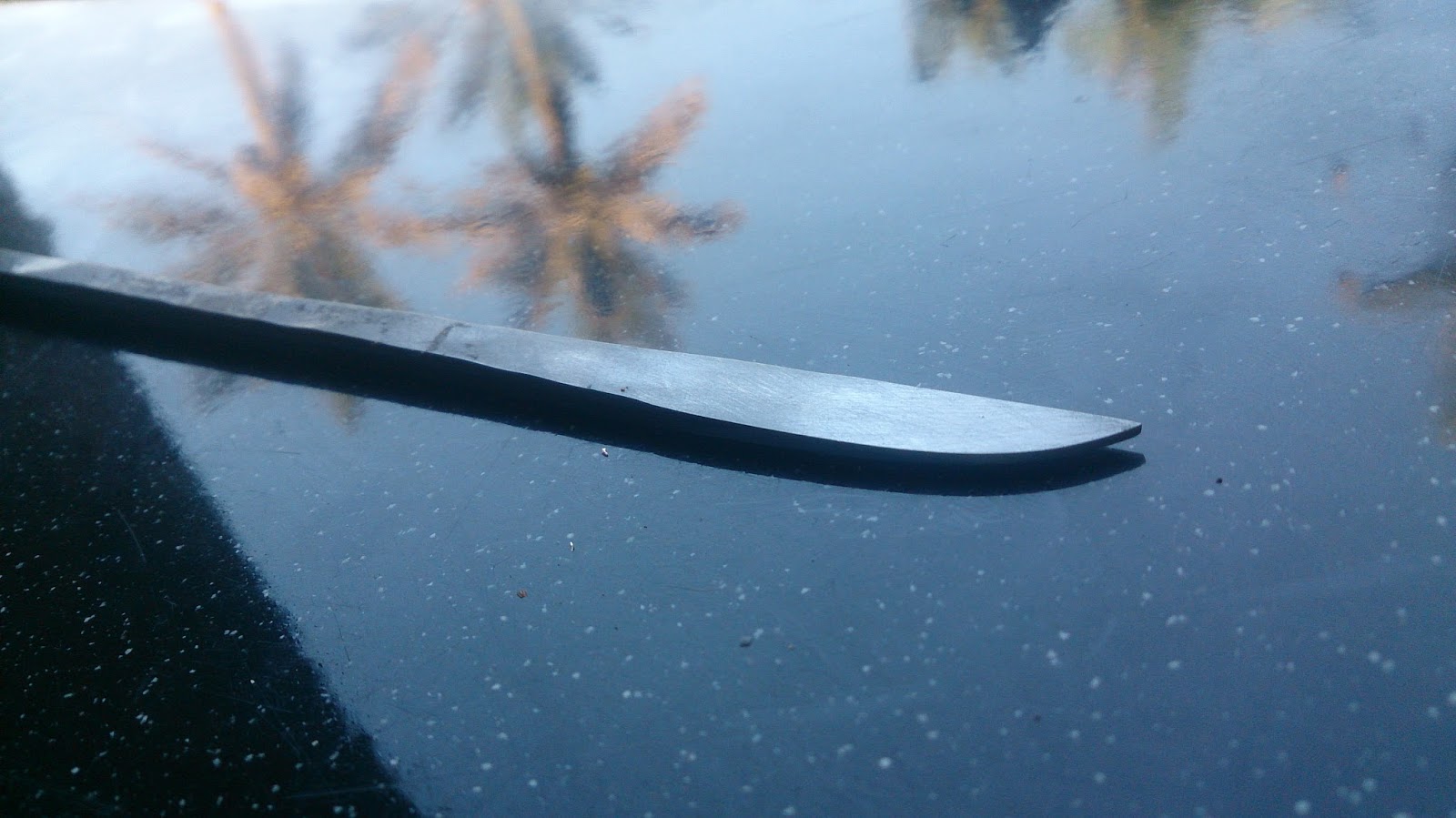
| Tagane |
| Tagane next to a steel ruler showing the length at approx. 11.5cm |
| This is a scraper, it is used to smooth out chisel marks before the abrasive stones |
| Another view of the same scraper, they are really effective and can also be used for subtle shaping |
Sunday, 10 May 2015
Sunday, 29 March 2015
New tagane
I made a new tagane, flat cut but with a rounded top, it let's me cut down at angles without hitting anything accidently with the top of the chisel. It means I can add volume and not just line.
Saturday, 14 March 2015
Titanium and tagane
It seems titanium is more demanding on the points of the tagane (tagane are the collective name for the types of chisels I am using) I may have to re-heat treat these or find a better material to make them from. The ones I have are high carbon steel but if I want to chisel titanium I may have to get some high speed stainless blanks. Tungsten I think would be too brittle.


Sunday, 12 October 2014
When heat treating is off
One of my chisels is going blunt really quickly. On closer inspection, I saw that the edge was rolling which means the steel is not properly hardened. This is probably the result of inaccurate tempering. I'll have to harden and temper the chisel again. It's difficult to get a good picture of the rolled edge but here is my attempt.


Wednesday, 1 October 2014
Tom Herman
Searching for references to the type of work I have in mind, I found the website of Tom Herman
Using a mixture of piercing and carving he makes intricate jewellery which seems to echo the use of borders and negative space found in decorative iron work. Although it's not explicit in his website, other articles about him have mentioned the making of tsuba as well as the use of chisels and tiny hammers so i can surmise he is using the same Japanese techniques I am interested in.
| This is almost exactly the type of work I picture when I say carving and decorative iron work. |
Monday, 1 September 2014
A productive weekend
I managed to get all the elements needed to make my pitch bowl and chisels.
I attached a brake part to a cut off bowls wood and filled most of the cavity with lead. I then melted the pine rosin and added plaster of paris, vegetable oil and a little black colouring. I found the recipe on the Following the Iron Brush forum. It has formed something akin to setters shellac rather than the softer pitch for reppouse. This makes sense as it's job is to hold the piece of metal while both hands are occupied with the hammer and chisel.
I also made a sand bag, just an old pillow case filled with garnet sand I had left over from a different project. Garnet sand great as it is denser than normal sand and the particles are all the same size as it is used in sand blasting.
I also cut old bastard files into strips to make the chisels. I was in contact with another knife maker who does this kind of work and he said old files are the right kind of steel. I still have to anneal the pieces, then shape their faces, then harden and temper them.


Friday, 1 August 2014
Thoughts and feelings around the art deco haircomb
While I was happy that I was able to inlay the silver, I had mixed feeling about the final look. The piece looked fine but the inlay was rough and unrefined. I felt like an amateur which is unusual for me in the metalwork arena.
I have been attracted to the Japanese way of working metal for a long time now but have not dared dive into it yet. The best way I can describe it is 'cold feet' I know that once involved it will consume much of my time and energy. For the practitioners who's work is worth looking at, it has become central to their lives.
So in order to get stuck in I have replaced the word nervous with excited and now I am very excited to give it a go. Fortunately, there is a master in this field who is free with his hard won information and very encouraging to all who contact him with a genuine interest. His name is Ford Hallam and he runs the forum Following the Iron Brush. This is a small example of his work:
The tools are the first step and so I have contacted a bladesmith who lives near me and he will help me with steel selection, heat treatment and grinding the profiles of the chisels.
Subscribe to:
Posts (Atom)