One of the things I admire most about Ford is his absolute commitment to the traditions taught to him by his sensei. There is a great integrity about not just his techniques but his approach to the way of learning and teaching the subject. All aspects of Japanese thought processes, aesthetic considerations and spiritual ethos are brought to bear on any subject he chooses to portray.
"The classical tradition which I'm presenting is a coherent system that has evolved over more than 1000 years and has given birth to some of the worlds most remarkable metal art. The methods and approach of these artists were not at all simple, nor easy, and any attempt to learn from the past it is sometimes going to entail doing things the hard way to ensure we don't miss something of value. The fact is we can only begin to asses the value of each aspect at the end of the learning process, not at the start."
Ford Hallam
It is not to just be able to replicate some skill level or make objects similar in look that I wish to attain, but to walk this particular path engenders a spirit of mindful approach which I am looking to grow within myself. This approach is exemplified in both Ford and many of his students.
The making of your own tagane, punches and hammers is the start of the skills required. Knowing good heat treating, how to grind, file and sharpen chisels is essential. These skills support good carving as there is often a place in a new piece which needs a different shape or size tool.
During the period swords were banned in Japan, makers of sword fittings turned their skills towards all metal work including jewellery, box inserts, netsuke and pots. This gives a precedent to be able to work on all forms of metal, the approach and techniques used are as important as the final piece.
Showing posts with label reference. Show all posts
Showing posts with label reference. Show all posts
Monday, 27 July 2015

Following the Iron Brush 2
As a reference for classical Japanese metalwork, especially as an English speaker, there is no better than Ford Hallam. When I first saw his work I was amazed, when I looked further and discovered the methods involved and the history of the tradition, my first thought was that moment of "when I grow up I want to do that!"
The only way it has been possible for me to access the knowledge I need to make the tools and learn their use has been through his Following the Iron Brush forum. There are various sections in the forum, from jewellery, art, netsuke and classical Japanese metalwork. Many users at different stages of development can share their experiences with excellent tips and tutorials by the more experienced people.
Ford is always available for comment if asked but usually the questions have been asked already and a quick search reveals the answer, often in more detail than I would have thought necessary.
The only way it has been possible for me to access the knowledge I need to make the tools and learn their use has been through his Following the Iron Brush forum. There are various sections in the forum, from jewellery, art, netsuke and classical Japanese metalwork. Many users at different stages of development can share their experiences with excellent tips and tutorials by the more experienced people.
Ford is always available for comment if asked but usually the questions have been asked already and a quick search reveals the answer, often in more detail than I would have thought necessary.
Sunday, 26 July 2015
Tiaan Burger part 2
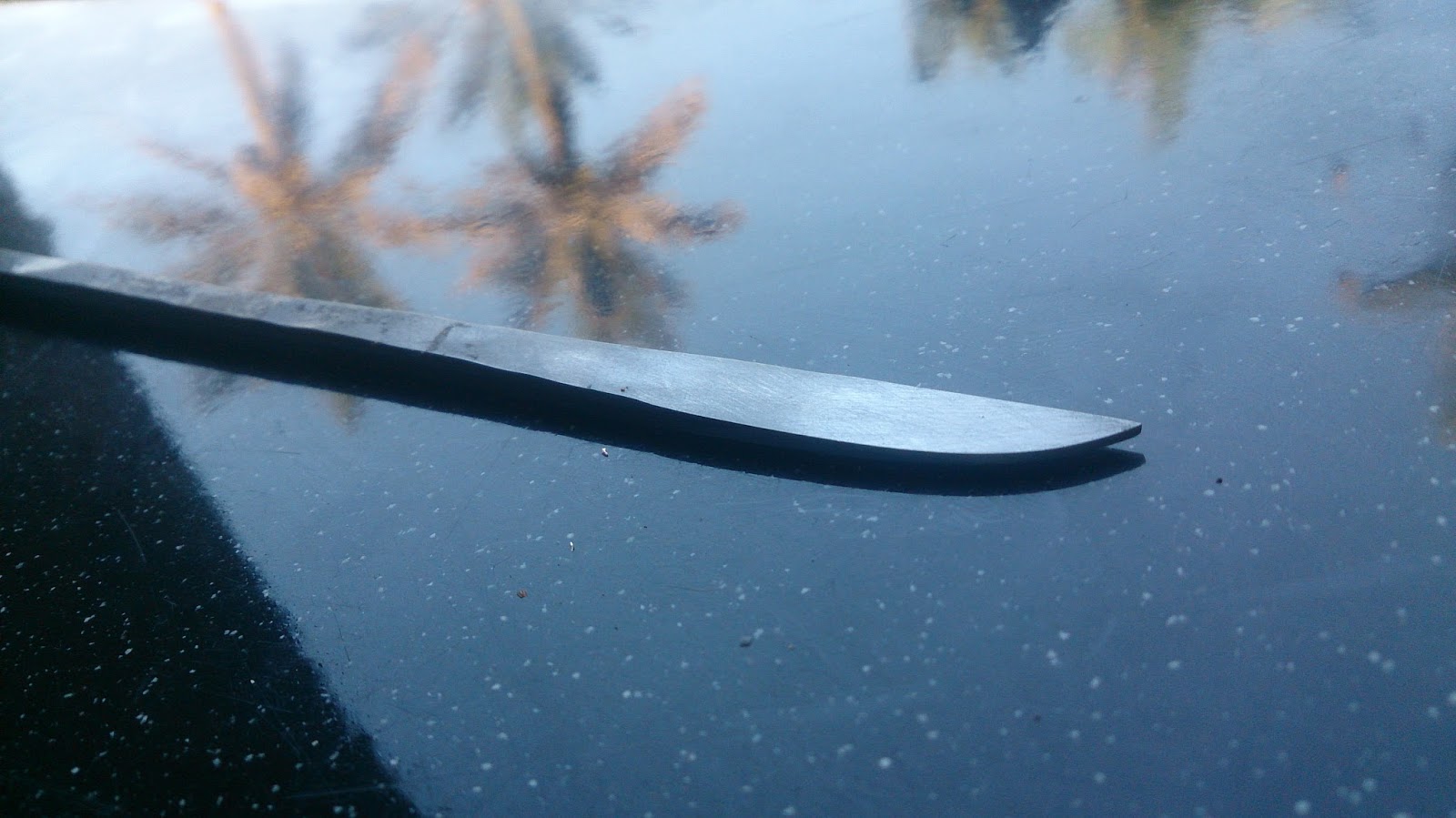
One of the major advantages I gained from the visit with Tiaan was to be able to see both the tools and some finished pieces in real life. Pictures and descriptions can be very misleading when trying to learn about something entirely new.
Tiaan's tagane were much more refined than the ones I had made thus far. The body and points were smaller. The angle of the cutting edge was steeper. These are things I find you can only see when actually holding an object. Tiaan is also very experienced with forging and working with steel so his tools are excellently made.
Tiaan's tagane were much more refined than the ones I had made thus far. The body and points were smaller. The angle of the cutting edge was steeper. These are things I find you can only see when actually holding an object. Tiaan is also very experienced with forging and working with steel so his tools are excellently made.
 |
| Tagane |
 |
| Tagane next to a steel ruler showing the length at approx. 11.5cm |
 |
| This is a scraper, it is used to smooth out chisel marks before the abrasive stones |
 |
| Another view of the same scraper, they are really effective and can also be used for subtle shaping |
Tiaan Burger
Tiaan Burger is a South African knifemaker and artist. I had been following his work on facebook because of the mutual interest in knife making. Recently he has also started posting some traditional Japanese carving which he learnt much the same way as myself, through the Iron Brush forum and by contacting Ford Hallam. He was able to spend some time in Ford's workshop as well which is something I would dearly like to do.
I contacted Tiaan and was fortunate enough to be able to interview him when he was in Durban on holiday. I am very interested in Tiaan's work because he doesn't just take Japanese techniques and carve Japanese motifs but rather uses Japanese techniques to carve South African scenery, fauna and flora. In the interview I asked about this and he said he likes to imagine a Japanese craftsman growing up in South Africa. The Japanese used their surroundings as inspiration, so too should we.
I contacted Tiaan and was fortunate enough to be able to interview him when he was in Durban on holiday. I am very interested in Tiaan's work because he doesn't just take Japanese techniques and carve Japanese motifs but rather uses Japanese techniques to carve South African scenery, fauna and flora. In the interview I asked about this and he said he likes to imagine a Japanese craftsman growing up in South Africa. The Japanese used their surroundings as inspiration, so too should we.
 |
| Traditional Japanese techniques and materials applied to South African scenery and animals. |
 |
| Gathering motifs from your surroundings |
 |
| Translating that into the traditional form of a tsuba or Japanese sword guard |
Saturday, 4 July 2015
Jake Powning
Jake Powning is a Canadian sword maker and wood carver. I have followed his work for several years. His work focusses on keeping ancient techniques and cultural concepts alive.
http://powning.com/jake/about-jake-2/
As a craftsman interested in ancient cultures and techniques, I really enjoy his pieces. He also writes a blog and interacts with people who share his interests.
It is encouraging to find these small pockets of people who are continuing and in some cases reverse engineering traditional techniques. In many cases it is not just a technique people are looking for but a way to share a certain mindset with those who came before.
In Powning's case the mindset is to walk the border between myth and reality, to cast aside modern cynicism and allow oneself to believe in a little magic just as our forebears did. In Jungian terms, the myth and magic are keys to our subconscious mind from whence creativity and art spring.
Something I struggle with in the creative process is to let go of my analytical cynical mind and allow myself to show the more child like, magic believing, dragon fearing side of my nature.
http://powning.com/jake/about-jake-2/
As a craftsman interested in ancient cultures and techniques, I really enjoy his pieces. He also writes a blog and interacts with people who share his interests.
It is encouraging to find these small pockets of people who are continuing and in some cases reverse engineering traditional techniques. In many cases it is not just a technique people are looking for but a way to share a certain mindset with those who came before.
In Powning's case the mindset is to walk the border between myth and reality, to cast aside modern cynicism and allow oneself to believe in a little magic just as our forebears did. In Jungian terms, the myth and magic are keys to our subconscious mind from whence creativity and art spring.
Something I struggle with in the creative process is to let go of my analytical cynical mind and allow myself to show the more child like, magic believing, dragon fearing side of my nature.
 |
| http://society6.com/jakepowning/prints |
Wednesday, 1 October 2014
Adam Garret
Adam Garret is a jeweller/engraver and uses engraving as a major part of the design. The scroll work and intricacy of his pieces are inspiring. He uses inlay, engraving as well as standard goldsmithing techniques to great effect.

Tom Herman
Searching for references to the type of work I have in mind, I found the website of Tom Herman
Using a mixture of piercing and carving he makes intricate jewellery which seems to echo the use of borders and negative space found in decorative iron work. Although it's not explicit in his website, other articles about him have mentioned the making of tsuba as well as the use of chisels and tiny hammers so i can surmise he is using the same Japanese techniques I am interested in.
Using a mixture of piercing and carving he makes intricate jewellery which seems to echo the use of borders and negative space found in decorative iron work. Although it's not explicit in his website, other articles about him have mentioned the making of tsuba as well as the use of chisels and tiny hammers so i can surmise he is using the same Japanese techniques I am interested in.
 |
| This is almost exactly the type of work I picture when I say carving and decorative iron work. |
Sunday, 7 September 2014
The Iron Brush
The metal artist Ford Hallam sparked an interest in traditional Japanese metal crafting within me. His work is at a master level and is recognised by the Japanese authorities as such. My first encounter was on Vimeo with this video. What impressed me is the absolutely traditional approach without power tools and modern abrasives absent.
The underlying ethos in Japanese carving is to see the chisels as an Iron Brush. To replicate the delicacy of ink and paper drawings in metal.
Different metals and alloys are used for their patination properties. Inlays, overlays, glazes, amalgam gilding and careful control of patina are all used to create pieces which can be studied at length and continue to fascinate.
You can see more of Ford Hallam's work here.
 |
| Tsuba or sword guard |
.jpg) |
| The subleties of patina |
 |
| Delicate carving |
 |
| Casually amazing inlay technique |
The underlying ethos in Japanese carving is to see the chisels as an Iron Brush. To replicate the delicacy of ink and paper drawings in metal.
Different metals and alloys are used for their patination properties. Inlays, overlays, glazes, amalgam gilding and careful control of patina are all used to create pieces which can be studied at length and continue to fascinate.
You can see more of Ford Hallam's work here.
Monday, 25 August 2014
Japanese metal carving
Here is a short video showing Ford Hallam applying Japanese style metal carving to a western style motif.
http://m.youtube.com/watch?v=sEmTdx6VuWk
If you watch, you will see a range of techniques I would like to start learning. I am in the process if making the tools I will need, pitch bowl, chisels and scrapers. I will also cut up some abrasive stones as there are places sandpaper and rubber wheels fail to reach when carving like this.
http://m.youtube.com/watch?v=sEmTdx6VuWk
If you watch, you will see a range of techniques I would like to start learning. I am in the process if making the tools I will need, pitch bowl, chisels and scrapers. I will also cut up some abrasive stones as there are places sandpaper and rubber wheels fail to reach when carving like this.
Tuesday, 12 August 2014

Wednesday, 7 May 2014
Conrad Hicks
Conrad Hicks is a Capetonian artist blacksmith, he forges gates, fences, sculpture, knives, kitchenware and furniture. Choosing a more traditional approach, all jointing is done using forge welding or riveting. Forge welding is where the steel is brought above forging temperature to white heat, placed next to or ontop of another piece of white hot steel and smashed together using either hand hammers or if the piece is large enough, power hammers.
The rationale behind using traditional techniques even though they take longer, is that you cannot replicate the look and feel of pieces made before arc welding was invented without following the same path as the old masters. A hole which is drifted looks different to a drilled hole, rivets which actually hold a piece in place look different to decorative rivets, mo matter how skillfully they are wrought.
" after I decided not to use arc welding in my designs, but rely wholly on blacksmithing techniques instead. Making this decision gave me a framework to work within and challenges to overcome, forcing me to push the boundaries of design possibilities. Imposing these limitations on myself gave my work meaning and it was in finding solutions to the problems I set, that I discovered my artistic purpose. " Conrad Hicks
I find that forging a piece of jewellery directly from the poured ingot gives me the same satisfaction. Somehow the route from smelting to finished piece speaks to the overall meaning, even if the it's not directly apparent to the observer. I think this is why I would like to leave some trace of the process in the finish.
"Keep your technique simple, but always be aware that your work reflects who you are. If you conform to mediocrity your work will never be anything more than mediocre. Your hammer marks are your brush strokes; they show how much you care for yourself and your work, and they can also reveal the opposite. Be proud of your ability to create a piece by hand, and wield your hammer with confidence. It is only through the development of self-awareness that we can create something truly unique." Conrad Hicks


The rationale behind using traditional techniques even though they take longer, is that you cannot replicate the look and feel of pieces made before arc welding was invented without following the same path as the old masters. A hole which is drifted looks different to a drilled hole, rivets which actually hold a piece in place look different to decorative rivets, mo matter how skillfully they are wrought.
" after I decided not to use arc welding in my designs, but rely wholly on blacksmithing techniques instead. Making this decision gave me a framework to work within and challenges to overcome, forcing me to push the boundaries of design possibilities. Imposing these limitations on myself gave my work meaning and it was in finding solutions to the problems I set, that I discovered my artistic purpose. " Conrad Hicks
I find that forging a piece of jewellery directly from the poured ingot gives me the same satisfaction. Somehow the route from smelting to finished piece speaks to the overall meaning, even if the it's not directly apparent to the observer. I think this is why I would like to leave some trace of the process in the finish.
"Keep your technique simple, but always be aware that your work reflects who you are. If you conform to mediocrity your work will never be anything more than mediocre. Your hammer marks are your brush strokes; they show how much you care for yourself and your work, and they can also reveal the opposite. Be proud of your ability to create a piece by hand, and wield your hammer with confidence. It is only through the development of self-awareness that we can create something truly unique." Conrad Hicks


Ashleigh George
Another jeweller who combines words with her pieces is Ashleigh George. She draws inspiration from nature and embeds parts of scripture from the bible into her jewellery. Whilst I'm not necessarily looking to scripture for the words I bond with my pieces, her work reiterates my point that more meaning can be brought to visual form through the addiction of words and phrases.
"Wearing The Word" is beautiful and an immense honor and privilege." says Ashleigh.
http://ashgeorgejewelry.com/about.html
 Written on the back of this bangle is:
….."So do not fear, for I am with you; do not be dismayed, for I am your God. I will strengthen you and help you; I will uphold you with my righteous right hand."
"Wearing The Word" is beautiful and an immense honor and privilege." says Ashleigh.
http://ashgeorgejewelry.com/about.html

….."So do not fear, for I am with you; do not be dismayed, for I am your God. I will strengthen you and help you; I will uphold you with my righteous right hand."
Wally Gilbert
Wally Gilbert is a rather wonderful "poltyglot" of metalcraft. Speaking the language of scuptor, jeweler, silversmith and manufacturer of decorative elements in architecture. It seems that instead of allowing the design sensibilities of each dicipline to influence him, he rather applies his design perspective to each dicipline. In a process which is almost the reverse of what I am attempting, he creates a body of work where he is the connecting feature, not the elements or techniques.
"I think of decoration and ornament not as an extra but as integral to the expression of any culture, and the medium through which I express myself."
http://www.wallygilbert.co.uk/index.htm

Bracelet
"I think of decoration and ornament not as an extra but as integral to the expression of any culture, and the medium through which I express myself."
http://www.wallygilbert.co.uk/index.htm
Bracelet
Andy Cooperman
Andy Cooperman blends techniques from different smithing traditions. In his words "We benefit from the explorations and innovations of countless generations of smiths--from goldsmiths and silversmiths to blacksmiths and tinkers--who built the foundations of metalsmithing and our innovations continue that tradition of discovery."
Using many techniques from blacksmithing, his examples have become important in my research. many of his rings are forged from the ingot and not rolled to shape the way a goldsmith would normally make a ring.
http://www.andycooperman.com


Here's the groom's ring. 14k rose gold, forged and fabricated from an ingot. The little "rivet" detail is 14k white gold. Below are some images of the fabrication. Right to left: The ingot forged into a blank. Annealing. Using the ring bender to shape the stubborn and thick gold. This last image shows how the "tail" of the forging is notched so that it sits smoothly atop the rest of the ring.


Using many techniques from blacksmithing, his examples have become important in my research. many of his rings are forged from the ingot and not rolled to shape the way a goldsmith would normally make a ring.
http://www.andycooperman.com
Here's the groom's ring. 14k rose gold, forged and fabricated from an ingot. The little "rivet" detail is 14k white gold. Below are some images of the fabrication. Right to left: The ingot forged into a blank. Annealing. Using the ring bender to shape the stubborn and thick gold. This last image shows how the "tail" of the forging is notched so that it sits smoothly atop the rest of the ring.
Stephen Einhorn
Not exactly a reference but a nice interaction which shows other designers are thinking along the same lines as me.


Monday, 5 May 2014
Jeanine Payer- Poetry with jewellery
"The idea of the secret is at the core of all that I make. The words are purposefully too tiny to read easily; this is the key to understanding what I am doing. It is always a process of mystery and discovery because the words are not immediately evident, and people sometimes have to use a magnifying glass. My work values the mysterious and revelatory in the way that poetry values these qualities with words. My designs are never about the ‘bling' and they are not for everyone; its artisanal, idiosyncratic, and very private."
Jeanine Payer inscribes poetry onto her jewellery, adding meaning in ways which would be difficult with visual cues alone. This is very similar to the way i wish to use poetry and lyrics with my pieces. I enjoy the concept of forcing people to examine the jewellery, looking for meaning in both the physical and metaphoric sense.
Her website is http://www.jeaninepayer.com/about


Jeanine Payer inscribes poetry onto her jewellery, adding meaning in ways which would be difficult with visual cues alone. This is very similar to the way i wish to use poetry and lyrics with my pieces. I enjoy the concept of forcing people to examine the jewellery, looking for meaning in both the physical and metaphoric sense.
Her website is http://www.jeaninepayer.com/about
I understood love to be the very gravity holding each leaf, each cell, this earthly star together.
-Joy Harjo
A mountain keeps an echo
deep inside itself. That's how I hold your voice.
-Rumi, trans. by Coleman Barks
deep inside itself. That's how I hold your voice.
-Rumi, trans. by Coleman Barks
Subscribe to:
Posts (Atom)